Contribution of Risk Factors to the Development of Ventilator-Associated Pneumonia in a Tertiary Hospital from January 2017 to December 2021
DOI:
https://doi.org/10.67474/lcpsp14.1.2026.16039Keywords:
Ventilator-Associated Pneumonia, Nosocomial infections, Intubation, risk factors, critical careAbstract
Background: Ventilator-Associated Pneumonia, is a new-onset pneumonia occurring 48 hours of intubation, recognized as a significant nosocomial infection globally, contributing to higher mortality. Currently, there are no studies regarding significant risk factors for VAP in local settings hence this study aims to identify the most significant risk factors for VAP among intubated patients in a tertiary hospital in Metro Manila, Philippines, from January 2017 to December 2021, providing a baseline for quality improvement interventions.
Methodology: A retrospective cohort study reviewed patient-related, treatment-related, and environment-related factors of all intubated adult patients in the critical care units during the study period.
Results: Out of 412 patients, 269 developed VAP. The mean age was 61, majority being male (66.01%). Patient-related factors: sex, age, and smoking history were not associated with increased VAP risk, while CKD (0.1066,p0.027) was associated with decreased risk. Reasons for intubation: CAP-HR (2.6703,p0.011) and HAP (3.8429,p0.042), increased VAP risk. Treatment-related factors: longer intubation days (9.8472, p 0.000), multiple antibiotic use (1.134,p0.000), and tracheostomy (6.8586, p 0.000) were linked to higher VAP risk. Empiric antibiotic therapy (0.3746,p0.000) decreased VAP risk. Environment-related factors showed that longer admission duration (1.0986,p0.000) increased VAP risk. ACS, septic shock, and lung cancer were linked to higher mortality, whereas COPD mitigated it. HAP,cor pulmonale, late-onset VAP, multiple antibiotic use, dialysis, and tracheostomy were associated with longer hospital stays. Paradoxically, components of the VAP prevention bundle like oral care and suctioning, correlated with increased mortality.
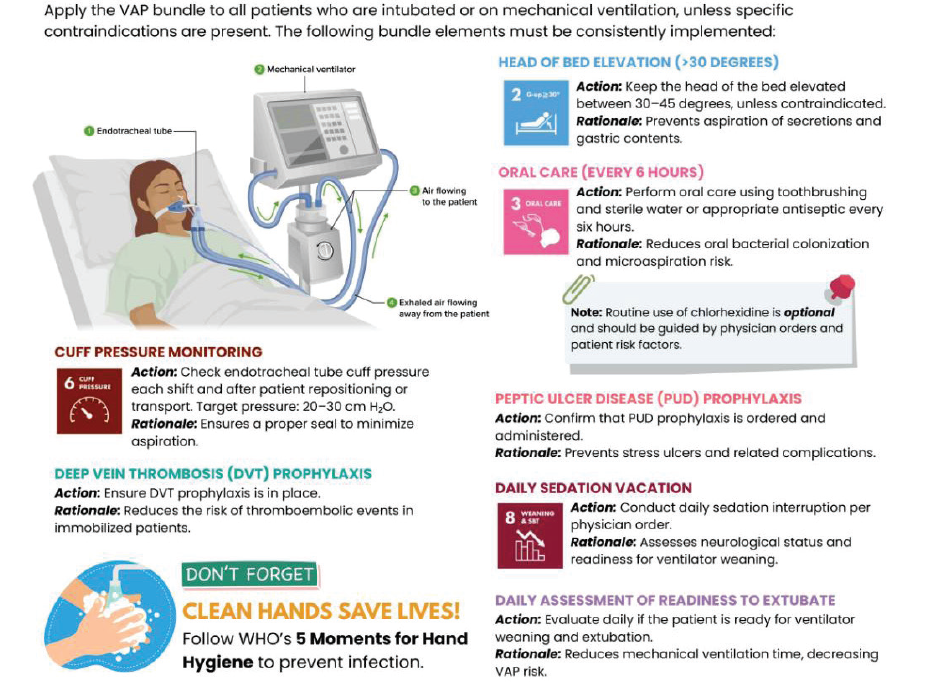
Conclusions: The study recommends thorough review and refinement of VAP prevention protocols, including how oral care and suctioning are done as it paradoxically correlates with increased mortality. Tailored prevention strategies targeting identified risk factors should be developed, and judicious antibiotic prescribing practices be emphasized. Quality improvement initiatives may help to optimize VAP prevention protocols and enhance patient care standards, ultimately reducing VAP burden.
References
1. Papazian L, Klompas M, Luyt CE. Ventilator-associated pneumonia in adults: a narrative review. Intensive Care Med. 2020;46(5):888-
906. https://doi.org/10.1007/s00134-020-05980-0
2. Zimlichman E, Henderson D, Tamir O, et al. Health care-associated infections: a meta-analysis of costs and financial impact on the US
health care system. JAMA Intern Med. 2013;173(22):2039-2046. https://doi.org/10.1001/jamainternmed.2013.9763
3. Blot S, Ruppé E, Harbarth S, et al. Healthcare-associated infections in adult intensive care unit patients: Changes in epidemiology,
diagnosis, prevention and contributions of new technologies. Intensive Crit Care Nurs. 2022;70:103227. https://doi.org/10.1016/j.iccn.2022.103227
4. Kharel S, Bist A, Mishra SK. Ventilator-associated pneumonia among ICU patients in WHO Southeast Asian region: A systematic
review. PLoS One. 2021;16(3):e0247832. https://doi.org/10.1371/journal.pone.0247832
5. Mastrogianni M, Katsoulas T, Galanis P, Korompeli A, Myrianthefs P. The Impact of Care Bundles on Ventilator-Associated
Pneumonia (VAP) Prevention in Adult ICUs: A Systematic Review. Antibiotics (Basel). 2023;12(2):227. https://doi.org/10.3390/
antibiotics12020227
6. Burja S, Belec T, Bizjak N, Mori J, Markota A, Sinkovi A. Efficacy of a bundle approach in preventing the incidence of ventilator associated pneumonia (VAP). Bosn J Basic Med Sci. 2018;18(1):105-109. https://doi.org/10.17305/bjbms.2017.2278
7. Khan R, Al-Dorzi HM, Al-Attas K, et al. The impact of implementing multifaceted interventions on the prevention of ventilator associated pneumonia. Am J Infect Control. 2016;44(3):320-326. https://doi.org/10.1016/j.ajic.2015.09.025
8. Bonten MJ, Kollef MH, Hall JB. Risk factors for ventilator-associated pneumonia: from epidemiology to patient management. Clin Infect Dis. 2004;38(8):1141-1149. doi:10.1086/383039
9. Blot S, Koulenti D, Dimopoulos G, et al. Prevalence, risk factors, and mortality for ventilator-associated pneumonia in middle-aged, old, and very old critically ill patients. Crit Care Med. 2014;42(3):601-609. doi:10.1097/01.ccm.0000435665.07446.50
10. Fabbri L, Pauwels RA, Hurd SS; GOLD Scientific Committee. Global Strategy for the Diagnosis, Management, and Prevention
of Chronic Obstructive Pulmonary Disease: GOLD Executive Summary updated 2003. COPD. 2004;1(1):105-104. doi:10.1081/
COPD-120030163
11. Silversides JA, Major E, Ferguson AJ, et al. Conservative fluid management or deresuscitation for patients with sepsis or acute
respiratory distress syndrome following the resuscitation phase of critical illness: a systematic review and meta-analysis. Intensive
Care Med. 2017;43(2):155-170. doi:10.1007/s00134-016-4573-3
12. Zaragoza R, Vidal-Cortés P, Aguilar G, et al. Update of the treatment of nosocomial pneumonia in the ICU. Crit Care. 2020;24(1):383.
Published 2020 Jun 29. doi:10.1186/s13054-020-03091-2
13. Martin-Loeches I, Povoa P, Rodríguez A, et al. Incidence and prognosis of ventilator-associated tracheobronchitis (TAVeM): a
multicentre, prospective, observational study. Lancet Respir Med. 2015;3(11):859-868. doi:10.1016/S2213-2600(15)00326-4
14. Azoulay E, Timsit JF, Tafflet M, et al. Candida colonization of the respiratory tract and subsequent pseudomonas ventilatorassociated
pneumonia. Chest. 2006;129(1):110-117. doi:10.1378/chest.129.1.110
15. Bustamante-Marin XM, Ostrowski LE. Cilia and Mucociliary Clearance. Cold Spring Harb Perspect Biol. 2017;9(4):a028241.
Published 2017 Apr 3. doi:10.1101/cshperspect.a02824116. Terragni PP, Antonelli M, Fumagalli R, et al. Early vs late tracheotomy for prevention of pneumonia in mechanically ventilated adult ICU patients: a randomized controlled trial. JAMA. 2010;303(15):1483-
1489. doi:10.1001/jama.2010.447
17. Deng H, Fang Q, Chen K, Zhang X. Early versus late tracheotomy in ICU patients: A meta-analysis of randomized controlled
trials. Medicine (Baltimore). 2021;100(3):e24329. doi:10.1097/MD.0000000000024329
18. Kollef MH, Morrow LE, Niederman MS, et al. Clinical characteristics and treatment patterns among patients with ventilator-associated pneumonia. Chest. 2006;129(5):1210-1218. doi:10.1378/chest.129.5.1210
Downloads
Published
How to Cite
Issue
Section
License
Copyright (c) 2026 Lung Center of the Philippines Scientific Proceedings

This work is licensed under a Creative Commons Attribution-NonCommercial 4.0 International License.
The Lung Center of the Philippines Scientific Proceedings is licensed under a Creative Commons Attribution-Non-Commercial 4.0 International license (CC BY-NC 4.0) which allows sharing, copying, and redistributing the material in any medium or format, under strict terms of giving appropriate credit to the authors and this journal, and use for non-commercial purposes.