Factors Associated with Intubation in Patients with Central Airway Obstruction Caused by Tumors: A Single-Center, Retrospective Cohort Study
Keywords:
Central airway obstruction, intubation, tumors, retrospective study, predictorsAbstract
Background: This single-center retrospective cohort study aimed to identify factors associated with intubation among patients with central airway obstruction (CAO) caused by tumors in the Lung Center of the Philippines.
Objectives: The primary aim is to identify the key variables contributing to the need for intubation in this patient population, thereby enhancing clinical understanding and potentially improving airway management strategies for individuals with CAO caused by tumors.
Methods: Data from patients admitted to the Lung Center of the Philippines from 2015 to 2023 and with a diagnosis of neck, lung, or intrathoracic tumors causing central airway obstruction (CAO) were retrospectively analyzed. Potential factors including age, sex, type, degree, location, degree, and type of obstruction, tissue diagnosis, and treatment received were assessed.
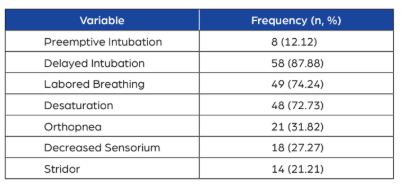
Results: Of 178 CAO patients, 37.08% required intubation during their hospital stay. Delayed intubation (88%) and an armored endotracheal tube (53%) were utilized in intubating these patients. Labored breathing (74%) and desaturation (73%) were prevalent symptoms. Univariable analysis revealed that the type of obstruction was significantly associated with intubation, with extraluminal obstruction and mixed obstruction, showing increased odds (OR 2.07 and OR 7.02, respectively) compared to endoluminal obstruction.
Conclusion: This study revealed labored breathing and desaturation as the most common symptoms in intubated CAO subjects. Univariable analysis showed that the type of obstruction was significantly associated with the need for intubation. Compared to those with endoluminal obstruction, patients with extraluminal obstruction had two times higher odds of intubation. In contrast, those with mixed obstruction had seven times higher odds. Multivariable analysis showed that the type of obstruction was the only statistically significant variable associated with the need for intubation.
References
1. Ernst A, Feller-Kopman D, Becker HD, Mehta AC. Central airway obstruction. Am J Respir Crit Care Med. 2004 Jun 15;169(12):1278-97. doi:10.1164/rccm.200210-1181SO. PMID: 15187010.
2. Mudambi L, Miller R, Eapen GA. Malignant central airway obstruction. J Thorac Dis. 2017 Sep;9(Suppl 10):S1087-110. doi:10.21037/jtd.2017.07.27. PMID: 29214067;PMCID: PMC5696549.
3. Ost DE, Ernst A, Grosu HB, Lei X, Diaz-Mendoza J, Slade M, et al. Complications following therapeutic bronchoscopy for malignant central airway obstruction: results of the AQuIRE registry. Chest. 2015 Aug;148(2):450-71. doi:10.1378/chest.14-2539. PMID: 25644902.
4. Ost DE, Ernst A, Grosu HB, Lei X, Diaz-Mendoza J, Slade M, et al. Therapeutic bronchoscopy for malignant central airway obstruction: success rates and impact on dyspnea and quality of life. Chest. 2015 May;147(5):1282-98. doi:10.1378/chest.14-1933. PMID: 25485563.
5. Daneshvar C, Falconer WE, Ahmed M, Sibly A, Hindle M, Nicholson TW, et al. Prevalence and outcome of central airway obstruction in patients with lung cancer. BMJ Open Respir Res. 2019 Sep 24;6(1):e000429. doi:10.1136/bmjresp-2019-000429. PMID: 31673363; PMCID: PMC6797367.
6. Giovacchini CX, Kessler ER, Merrick CM, et al. Clinical and radiographic predictors of successful therapeutic bronchoscopy for relieving malignant central airway obstruction. BMC Pulm Med. 2019 Nov 18;19(1):219. doi:10.1186/s12890-019-0987-3. PMID: 31739764; PMCID: PMC6852060.
7. Powers RE, Schwalk AJ. Overview of malignant central airway obstruction. McGovern Medical School, The University of Texas Health Sciences Center at Houston; The University of Texas Southwestern Medical Center, Dallas, TX.
8. Slinger P, Campos JH. Anesthesia for thoracic surgery. In: Miller RD, editor. Miller's Anesthesia. 8th ed. Philadelphia: Elsevier; 2015. p.
1942-85.
9. Usuda K, Iwai S, Yamagata A, Ishikawa M, Kato M, Murakami J, et al. Clinical outcomes and survival following placement of self-expandable
metallic stents for central airway stenosis and fistula. Thorac Cancer. 2021 Jan;12(1):48-56. doi:10.1111/1759-7714.13707. PMID: 33179865; PMCID: PMC7779193.
10. Barach AL. The use of helium in the treatment of asthma and obstructive lesions in the larynx and trachea. Ann Intern Med. 1935;9:739-65.
11. Brewer LA, Bai AF, Little JN, et al. Carcinoma of the lung: practical classification for early diagnosis and surgical treatment. JAMA. 1958;166:1149-55.
12. Brewer LA. Patterns of survival in lung cancer. Chest. 1977;71:644-50.
13. Line DH, Deeley TJ. The necropsy findings in carcinoma of the bronchus. Br J Dis Chest. 1971;65:238-42.
14. Guedes F, Branquinho MV, Sousa AC, et al. Central airway obstruction: is it time to move forward? BMC Pulm Med. 2022;22(1):68. doi:10.1186/s12890-022-01862-x. PMID: 35139857; PMCID: PMC8824825.
15. Cavaliere S, Venuta F, Foccoli P, Toninelli C, La Face B. Endoscopic treatment of malignant airway obstructions in 2,008 patients. Chest.
1996 Dec;110(6):1536-42. doi:10.1378/chest.110.6.1536. PMID: 8989073.
Downloads
Published
How to Cite
Issue
Section
License
Copyright (c) 2025 Lung Center of the Philippines Scientific Proceedings

This work is licensed under a Creative Commons Attribution-NonCommercial 4.0 International License.
The Lung Center of the Philippines Scientific Proceedings is licensed under a Creative Commons Attribution-Non-Commercial 4.0 International license (CC BY-NC 4.0) which allows sharing, copying, and redistributing the material in any medium or format, under strict terms of giving appropriate credit to the authors and this journal, and use for non-commercial purposes.